
The Silence of a Genius: Why AR Rahman’s 7-Day Digital Detox for ‘Ramayana’ Is a Game Changer

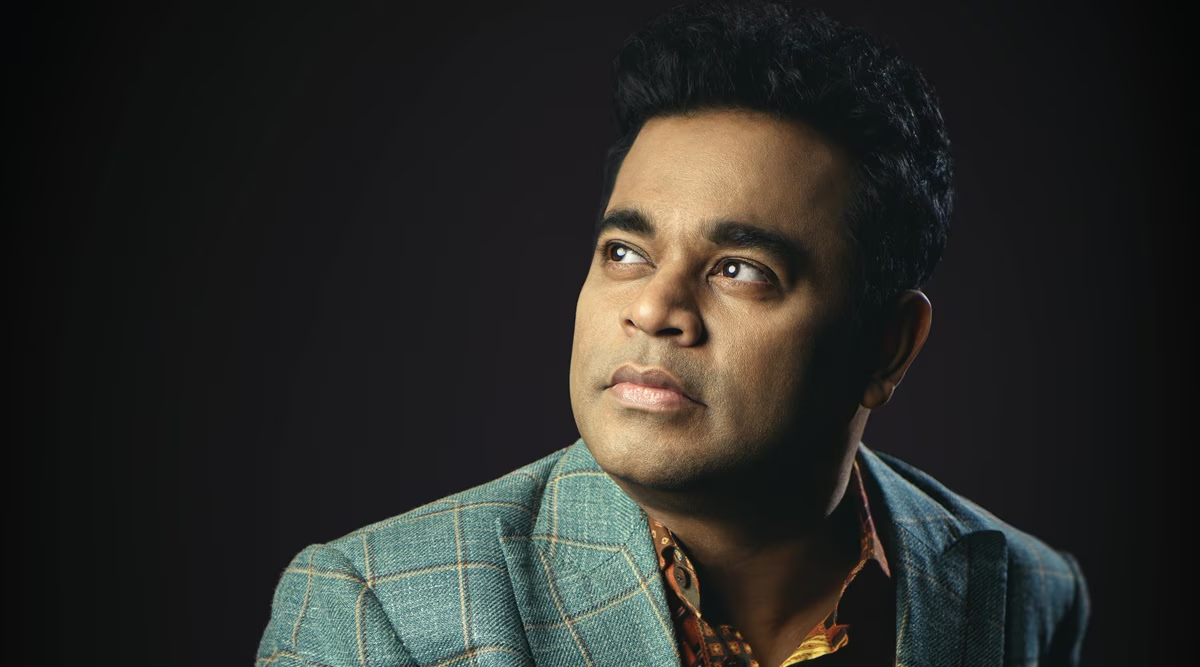
Chennai, Tuesday — The Mozart of Madras has officially gone off the grid, and if you are looking for a reply to your DM or a tweet from the legend, you might want to hold your breath for at least a week because AR Rahman has just hit the “Do Not Disturb” button on his life.
In a move that has sent shockwaves through both the tech world and the film industry, the Oscar-winning composer has announced a total digital detox for the next seven days to lock himself in his studio and finish the background score for what is arguably the biggest cinematic gamble in Indian history: Nitesh Tiwari’s Ramayana.
This isn’t just about a musician taking a break from social media noise; it is about a master craftsman entering a “monk mode” to breathe life into the soul of an epic that a billion people already have a soundtrack for in their heads.
The silence is loud, boss. We are talking about a project where the stakes are so high they might actually be visible from space. Nitesh Tiwari isn’t just making a movie; he is trying to define a generation’s visual and auditory memory of the most sacred story in the land. When you have Ranbir Kapoor as Ram, Sai Pallavi as Sita, and the “Monster” Yash as Ravana, you don’t just “compose” music—you try to capture divinity. Rahman knows this better than anyone.
He knows that every sitar pluck and every orchestral swell will be scrutinized by millions of fans who have grown up on the haunting melodies of the past. The pressure is immense, the timeline is tight, and the maestro has realized that he cannot find the “divine sound” while his phone is buzzing with notifications about viral reels or industry gossip.
The timing of this detox is no coincidence either. There is a massive event looming in March 2026 where the team is expected to finally pull back the curtain on the full technical wizardry of this megaproject.
👇 Receive Box Office Updates, sent directly to your device by your personal Box Office Insider. 👇
👇 Join the inner circle 👇
Sources suggest that the background score needs to be “locked and loaded” before that unveiling because the music is meant to be the spine of the entire presentation. According to AR Rahman’s official announcement on X (formerly Twitter), this seven-day blackout is strictly dedicated to the “sonic landscape” of Ramayana. The maestro himself hinted that ahead of the major event, he needs to be one with the narrative, away from the digital chaos that clutters the creative mind. It is a direct source, straight from the man himself, making it clear that the “Ramayana sprint” has officially begun.
What makes this even more fascinating is the “HansRah” factor. Remember the selfie that broke the internet? AR Rahman and the legendary Hans Zimmer—the man behind Inception, The Dark Knight, and Dune—are working together on this. This is the crossover of the century.
You have Zimmer’s massive, earth-shaking Western orchestral power meeting Rahman’s deeply spiritual, rooted, and emotive Indian melodies. But even for two legends, merging these two worlds is “terrifying,” as Rahman has previously admitted in interviews. They aren’t just making a soundtrack; they are trying to unlearn their own instincts to create something that feels timeless yet brand new. Imagine the creative friction in that room! Zimmer brings a global perspective, while Rahman ensures the heart of the story remains local.
The project is being mounted on a budget of roughly 4,000 crores, split across two parts, with the first installment slated for Diwali 2026. Everything about this film is “maximized”—from the VFX by DNEG to the stunt coordination. But at the end of the day, a movie like Ramayana succeeds or fails on emotion. If the music doesn’t make you feel the pain of exile or the glory of victory, the 4K visuals won’t save it.
That is why Rahman’s detox is so significant. He isn’t just working on tracks; he is working with the poetic genius Dr. Kumar Vishwas to ensure that the lyrics and the score are perfectly synced to the spiritual gravitas of the original text. Vishwas, who is a pro at the Hindi language and the nuances of the epic, is providing the “literary spine” that Rahman is now wrapping his music around.
Think about the discipline it takes to step away from the world for seven days. In an era where even a ten-minute phone-less period feels like an eternity, the world’s most busy composer is choosing silence. It shows the level of devotion Nitesh Tiwari has managed to inspire in his team. This isn’t just a job for them; it is a responsibility. They are aware that they are handling “Our Truth, Our History,” as the film’s tagline suggests. Every note has to be perfect.
Every silence in the score has to mean something. Rahman is looking for those specific frequencies that resonate with the soul, and apparently, those frequencies don’t exist in the same space as the 5G signals of our smartphones.
As the industry waits with bated breath for the March event, the narrative is shifting from “who is in the cast” to “how will it sound.” The buzz in the trade circuits is that the score Rahman is currently polishing is unlike anything we have heard in Indian cinema. It is supposed to be immersive, almost like a 3D audio experience that transports you back to the Treta Yuga.
If he pulls this off, it won’t just be a career highlight for him; it will be a benchmark for global cinema. For now, the studio in Chennai is a fortress of silence, and we can only imagine the magic being cooked up behind those closed doors. The maestro is silent, the digital world is waiting, and the epic is slowly finding its voice.
Look, I’ve seen stars take “breaks” for marketing, but AR Rahman is different. When he goes quiet, the world eventually hears something loud and beautiful. I think this digital detox is a fantastic sign. It shows he isn’t treating Ramayana as just another “big-budget assignment.” He’s treating it with the reverence it deserves. In an age of factory-made music, having the “Mozart of Madras” go into deep-focus mode tells me we are in for a masterpiece. It’s good news, period. It means the soul of the film is in safe, focused hands.
My Take
Original Source: Confirmed directly via AR Rahman’s official X (formerly Twitter) account.
Question For You: If you had to pick one scene from the Ramayana that absolutely needs an epic AR Rahman-Hans Zimmer background score to work, which one would it be? Exile, the bridge construction, or the final battle? Let me know in the comments!
Join BoxOfficeWala
Get Box Office Updates directly on WhatsApp from your personal Box Office Insider.
You May Have Missed




About the Author

Nitesh Mishra
— Business Analyst (Since 2017)
As a Movie buff with years of experience in film blogging, writing and box office analysis, I specialise in delivering accurate box office insights, movie updates OTT deals and Business Insights. [X, Instagram, Reddit, Threds]