
Akshay Kumar’s Bhooth Bangla OTT Rights: Why Netflix Paid Nearly 100 Crore?


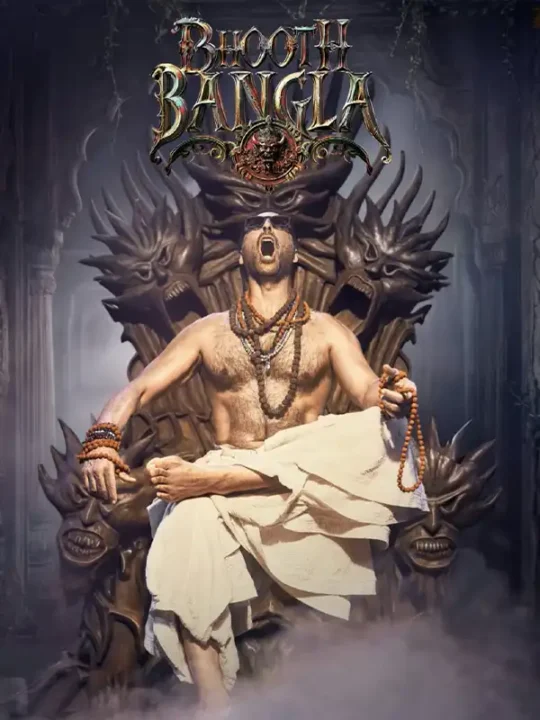
MUMBAI — The digital battlefield has a new undisputed champion, and its name is Bhooth Bangla. In a move that has sent shockwaves through the trade circuits, Netflix has reportedly locked the digital acquisition of Priyadarshan’s horror-comedy for a staggering sum nearing the 100-crore mark.
While the makers have been playing their cards close to their chest, the buzz in the Mumbai film markets confirms that the deal is valued at approximately Rs 98 crore.
This puts the Akshay Kumar starrer in the elite league of digital deals, nearly covering its entire production cost before the theatrical run even concludes.
The Strategic Power of the Akshay-Priyadarshan Reunion
This deal isn’t just about big numbers.
It is a masterclass in market windowing and legacy value. Bhooth Bangla marks the reunion of Akshay Kumar and director Priyadarshan after a long gap of 14 to 16 years. Their track record of comedy classics like Hera Pheri and Bhool Bhulaiyaa created a massive psychological hook for audiences and streamers alike.
From a trade perspective, Netflix isn’t just buying a movie; they are buying the nostalgia and the proven chemistry of a duo that defines the genre.
The broader market impact here is massive. We are seeing a significant shift in how big-budget projects are structured. By securing a Rs 98 crore deal against a reported production budget of Rs 120 crore, the producers have effectively mitigated their theatrical risk.
This allows the film to breathe at the box office, where it has already grossed over Rs 214.95 crore worldwide. For the industry, this is a clear signal that horror-comedy remains the most bankable genre in the current climate, capable of driving both massive footfalls and premium digital prices.
A Reality Check on the “Success” Narrative
Despite the celebratory mood around the Rs 98 crore OTT deal and the theatrical triumph, the current market mood carries a sharp edge of scepticism.
Why are we seeing headlines about unpaid dues while the producers celebrate a 200-crore hit?
This is the contrarian question everyone is whispering. Reports have recently surfaced claiming that several vendors associated with the film are still waiting for payments totalling nearly Rs 48 lakh.
One vendor allegedly claimed a pending fee of Rs 30 lakh, noting that once a film releases, getting money out becomes a nightmare as the standard 90-day invoice clearance has vanished. It is a classic industry paradox.
On one hand, you have a massive ROI and a lucrative Netflix acquisition.
On the other hand, the ground-level workforce is struggling to clear its balance sheets. Does a high digital acquisition price truly mean a “healthy” film if the production pipeline is clogged with payment delays?
Bhooth BanglaDay 68
Breaking Down Bhooth Bangla 120-Crore Math
To understand the logic behind the Rs 98 crore Netflix price tag, you have to look at the financial blueprint of Bhooth Bangla.
The film was mounted on a budget of Rs 120 crore. Usually, an Akshay Kumar film of this scale would see a massive chunk going to his upfront fee. However, for Bhooth Bangla, Akshay took a strategic pay cut, charging an upfront fee of only Rs 18 crore. For context, he reportedly charged Rs 70 crore for Jolly LLB 3.
So, where did the money go?
It went into the backend deal. Akshay holds a 70 per cent share of the film’s profits as a co-producer, while Ektaa Kapoor’s Balaji Motion Pictures holds the remaining 30 per cent. This model is pure financial science. By keeping upfront costs low, the makers ensured that the movie reached its breakeven point much faster.
The digital rights sale to Netflix for Rs 98 crore basically acts as a massive insurance policy, covering nearly 82 per cent of the production cost.
According to industry reports from The Economic Times and NDTV, the supporting cast fees were also kept incredibly efficient:
- Tabu reportedly earned Rs 2 crore.
- Rising star Wamiqa Gabbi charged Rs 1 crore.
- Comic legend Rajpal Yadav took home approximately Rs 75 to 80 lakh.
This lean payroll allowed Priyadarshan to spend more on the visual scale, including the grand ancestral property in the village of Mangalpur.
When Netflix evaluates a property, they look at this “production value.” They see an ensemble cast, a legendary director-actor duo, and a genre—horror-comedy—that has historically high retention rates on streaming platforms.
BoxOfficeWala Verdict
As we move toward the OTT release in late June or early July 2026, the verdict is clear. Bhooth Bangla is a textbook example of how to monetise a film in the post-pandemic era.
The makers used psychological storytelling—relying on the “neural coupling” of fans to their previous hits—to ensure a high opening. By selling the rights to Netflix for Rs 98 crore, they have essentially turned their theatrical run into pure profit territory.
Is this good news for the industry? Yes, because it proves that sensible budgeting and profit-sharing can save even a high-budget film from being a theatrical “flop.”
However, the lingering vendor payment issues serve as a warning.
We cannot celebrate a “98-crore deal” if the backbone of the industry—the vendors and crew—are not being paid on time. For the industry to truly thrive, the profit from these massive OTT deals must trickle down efficiently.
With Netflix paying Rs 98 crore for a 120-crore film, do you think the “theatrical window” is becoming secondary to digital acquisition, or is the box office still the ultimate judge of a superstar’s market value?
Join BoxOfficeWala
Get Box Office Updates directly on WhatsApp from your personal Box Office Insider.
You May Have Missed




About the Author

Nitesh Mishra
— Business Analyst (Since 2017)
As a Movie buff with years of experience in film blogging, writing and box office analysis, I specialise in delivering accurate box office insights, movie updates OTT deals and Business Insights. [X, Instagram, Reddit, Threds]